
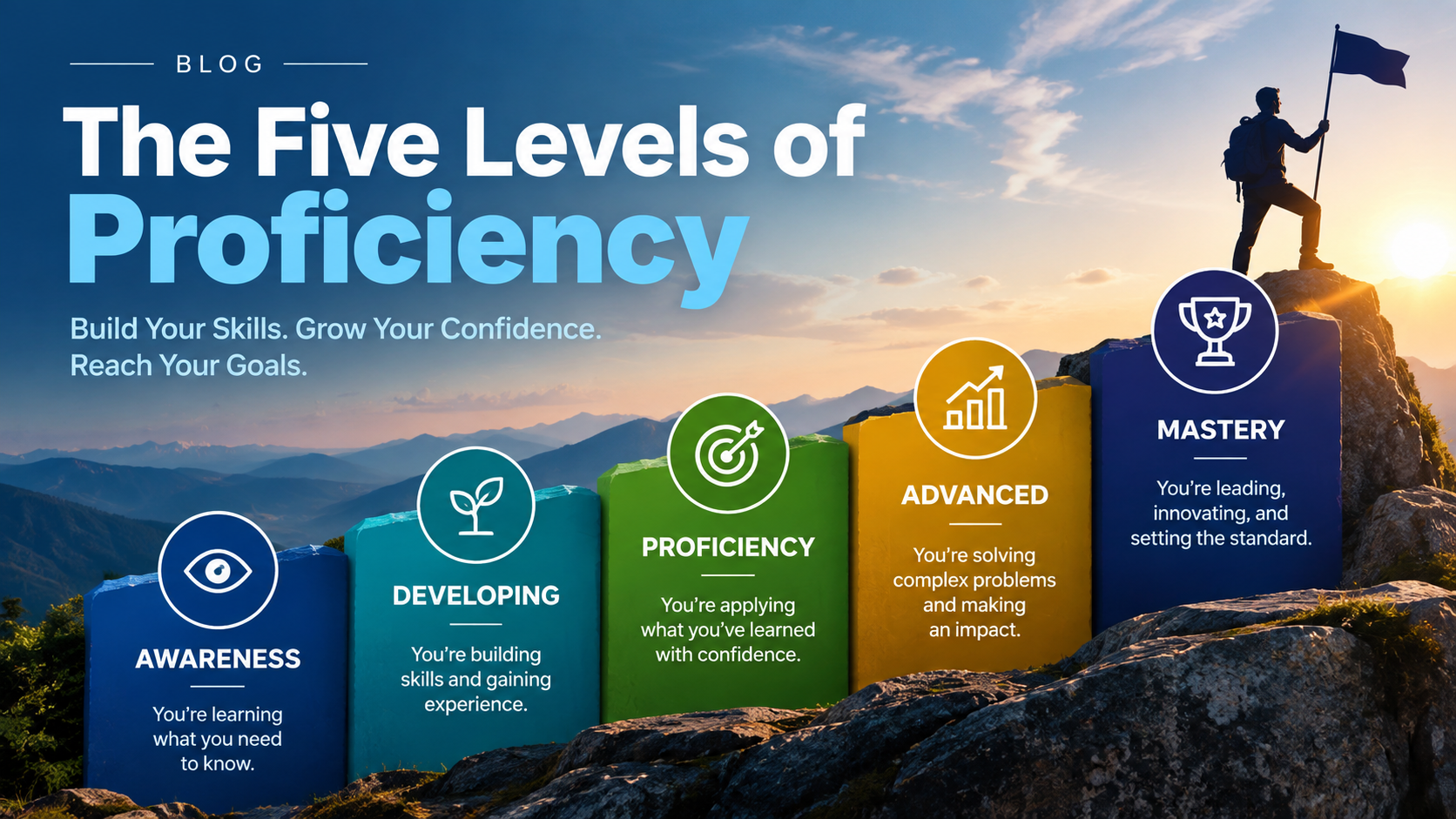
The Five Levels of Proficiency
Why Proficiency Is a Starting Point, Not an Endpoint
In any field, there is a difference between knowing something, being able to do it, and being able to use that knowledge effectively under changing circumstances.
Skill development follows a similar progression.
A person may first become aware of a subject, then learn to perform the basic tasks, and eventually become proficient. At that point, the person can perform the work independently and consistently.
That is useful. But it raises an important question:
What should happen after proficiency?
The answer is not necessarily to work harder or to pursue mastery for its own sake. The more useful question is whether additional development will increase a person's effectiveness.
Skills have value because of what they enable a person to accomplish. As responsibilities change, the skills required for effectiveness change with them.
The five levels of proficiency provide a useful framework for understanding that development.
Level 1 — Awareness
"I Know What It Is."
Awareness is the beginning of skill development.
A person becomes familiar with a subject, understands its basic concepts, and recognizes where it may be useful.
At this stage, the person may have read about a subject, attended training, observed someone with experience, or received an introduction to the fundamentals.
But awareness should not be confused with capability.
Knowing what leadership involves, for example, does not necessarily make someone an effective leader. Understanding financial principles does not necessarily mean someone can manage a budget effectively.
The purpose of awareness is to establish a foundation for further learning.
The useful question is:
"What do I need to learn?"
Level 2 — Developing
"I Can Do It With Guidance."
At the developing stage, knowledge begins to become capability.
The individual starts applying what has been learned. Instructions, examples, coaching, and feedback remain useful. Performance may be inconsistent, particularly when circumstances differ from those encountered during training.
This is the stage where practice matters most.
The individual is learning not only what to do, but how the skill works in actual situations.
Errors and corrections are part of the process. Feedback becomes an important source of information about what needs to change.
The useful question is:
"How can I improve my performance?"
Level 3 — Proficient
"I Can Do It Independently."
Proficiency represents an important achievement.
The individual can perform the skill without continuous supervision. Normal situations can be handled independently, and results are generally consistent.
For many positions, this is exactly what is required.
But proficiency has a specific meaning: the person can meet the expected standard.
That does not necessarily mean the person can handle unusual circumstances, improve the process, teach others, or adapt the skill to a new environment.
This distinction matters.
Organizations and individuals often make the mistake of treating proficiency as the final stage of development. In reality, proficiency establishes a dependable level of performance from which further development can take place.
The useful question becomes:
"What would make this capability more valuable?"
Level 4 — Advanced
"I Can Adapt, Improve, and Teach."
At the advanced level, the individual moves beyond the routine application of a skill.
The person understands not only what to do, but increasingly why it works.
That understanding creates flexibility.
When circumstances change, the individual can adjust the approach. When a problem occurs, the person can diagnose it rather than simply follow a procedure. When an existing method is inefficient, the individual can identify an alternative.
Another characteristic becomes important at this level: the ability to transfer knowledge.
A person who can teach a skill demonstrates a different level of understanding from someone who can only perform it.
The focus also begins to shift from individual performance to organizational or team effectiveness.
The useful question is:
"How can this capability improve the performance of others?"
Level 5 — Mastery
"I Can Create, Improve, and Lead."
Mastery is not the same as knowing everything.
It is a high level of practical understanding that allows a person to deal effectively with situations that cannot simply be handled by applying a standard procedure.
A person operating at this level can identify patterns, develop solutions, improve systems, teach others, and make informed decisions when the answer is not obvious.
The distinction between advanced capability and mastery is often the ability to create rather than merely apply.
The proficient individual applies the established method.
The advanced individual can adapt the method.
The master can determine whether the method itself should be changed.
This is where expertise begins to have a broader effect.
The useful question becomes:
"What can I improve, create, or enable that was not possible before?"
Why Proficiency Should Not Be the End
There is nothing wrong with being proficient.
In many circumstances, proficiency is exactly what is needed.
The issue is whether the demands of the situation have changed.
A skill that was sufficient for one responsibility may not be sufficient for another. A technology may change. A business process may change. A person's responsibilities may expand.
Development therefore should not be based simply on the desire to reach a higher level.
It should be connected to purpose and effectiveness.
The important question is not:
"How advanced can I become?"
It is:
"What level of capability does the work require, and what additional capability would make me more effective?"
That question makes skill development practical.
The Difference Between Performing and Improving
Consider two people who use the same technology.
The proficient user knows how to complete the required tasks.
The advanced user understands how to troubleshoot problems and identify more efficient methods.
The highly developed user understands the system well enough to train others, improve the process, recognize opportunities, and determine when a different solution would produce better results.
All three may be capable of completing the same task.
The difference is in the scope of their contribution.
Skill development is therefore not simply about accumulating knowledge.
It is about increasing the range of situations in which a person can perform effectively and increasing the value that person can create.
Development Should Have a Purpose
The objective of skill development is not to turn everyone into an expert at everything.
That would neither be practical nor necessary.
The objective is to identify which capabilities matter, determine the level required, and develop those capabilities accordingly.
Some skills require basic awareness.
Others require reliable proficiency.
Certain responsibilities require advanced judgment.
And some roles require deep expertise.
The important thing is to know the difference.
Proficiency establishes competence. Development expands effectiveness.
The question for anyone seeking to improve is therefore a simple one:
"What capability would make me more effective, and what level of proficiency does that capability require?"
That is a more useful approach to development than simply trying to become better at everything.
Because the purpose of developing a skill is not the skill itself.
The purpose is what you become capable of doing with it.